The UN Volunteers programme promotes volunteerism to support peace and development worldwide. During 2025, 17,169 UN Volunteers from 182 countries supported 59 partner UN entities in their peace and development activities in 172 countries.

In 2025, annual contributions to
other resources increased to $4.6 billion,
up by 6 percent from $4.3 billion in 2024.
Other resources are earmarked contributions that supplement regular or core resources.
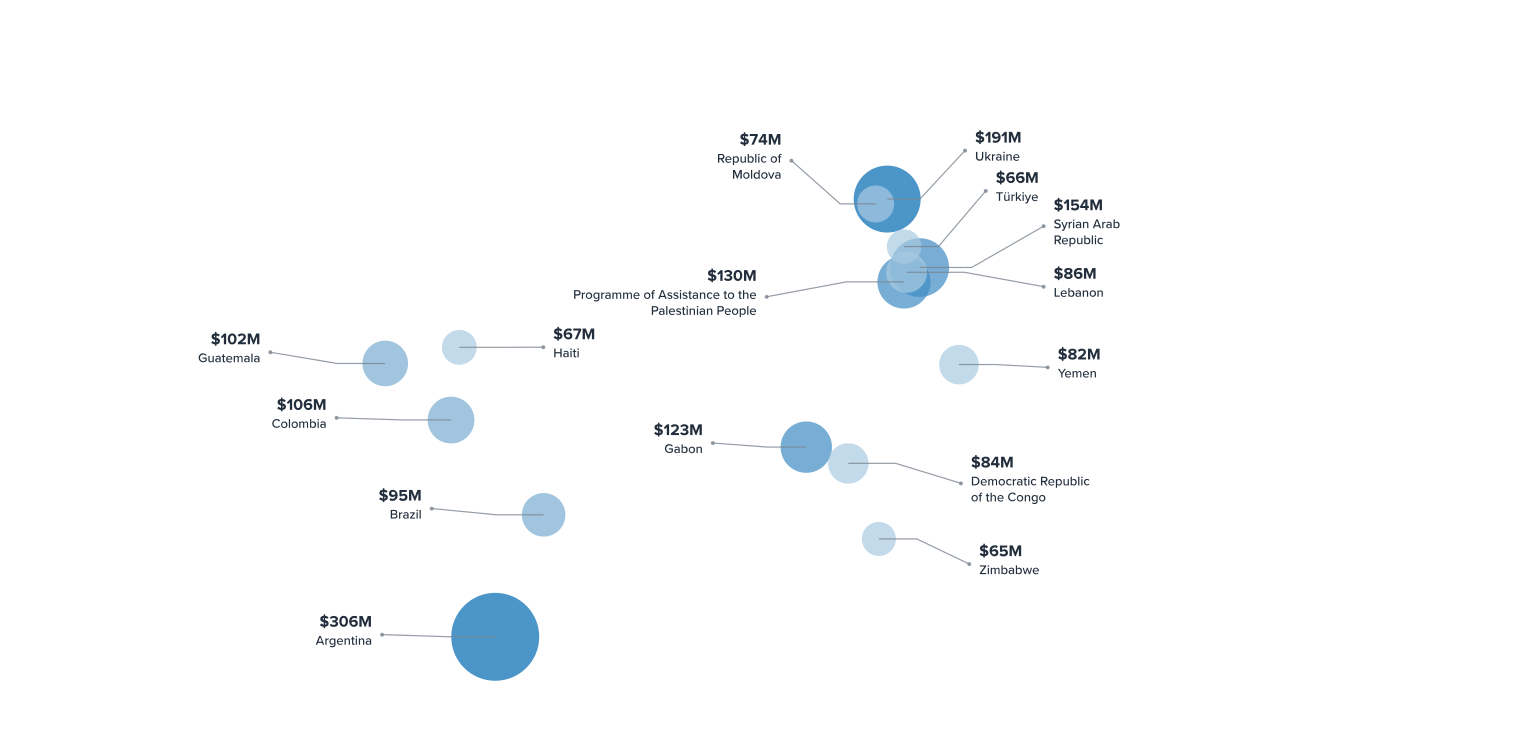
The funding windows remain UNDP’s principal flexible funding instrument after regular resources, providing critical support for integrated programming. In 2025, contributions to the funding windows declined to $115 million from $133 million in 2024. UNDP is grateful for the continued support of our partners for the funding windows.
Hover or tap a contributor, funding window or flow to see its breakdown.
A UN inter-agency pooled fund is a financing mechanism that supports a clearly defined programmatic purpose and results framework through contributions from more than one contributor. These funds enable global, regional and country-level responses to humanitarian, development, peace and transition and climate and environment-related challenges.
In 2025, UNDP remained the largest participating organization in inter-agency pooled funds, receiving $234 million, down by 7 percent from $251 million in 2024.
Government development financing is a voluntary funding mechanism through which programme country governments entrust their domestic resources, or loans extended by international financial institutions (IFIs), to UNDP to assist in implementing development initiatives in their respective countries.
Total government financing in 2025, representing 28 percent of total resources and a 17 percent increase from 2024.
Financed through loans from international financial institutions.
In 2025, programme countries in Latin America and the Caribbean contributed 62 percent of total government financing, followed by Africa (17 percent), Europe and the Commonwealth of Independent States (9 percent), the Arab States (8 percent), and Asia and the Pacific (4 percent).
Vertical funds are earmarked for a single area of development such as nature, climate, energy or health. These funds are governed by steering committees and are not directly administered by UNDP.
In 2025, UNDP received $825 million from vertical funds, an 11 percent decrease from the $920 million received in 2024. The largest contributions came from the Global Environment Facility ($372 million), the Global Fund ($311 million) and the Green Climate Fund ($84 million).
Earmarked contributions to a specific programme or project continue to account for the largest share of UNDP resources. In 2025, these contributions amounted to $1.95 billion (39 percent of total resources).
As UNDP’s third-largest donor in 2025, the European Union remains a strong partner. It contributed $313 million for UNDP programmes in Türkiye, Lebanon, Nigeria, Cyprus, Bosnia and Herzegovina, the Philippines and other countries, a 3 percent increase from the $305 million received in 2024.
UNDP’s financial and non-financial partnerships with IFIs are central to promoting $1 trillion in public expenditure and private capital investments aligned with the SDGs.
In 2025, UNDP received $316 million from IFIs, an 8 percent decrease from $344 million in 2024. The top IFI contributors were Kreditanstalt für Wiederaufbau (KfW) at $105 million and the World Bank at $88 million. This funding comprised $203 million in direct grants and $113 million in indirect government contributions.
Contributions from the private sector, foundations, non-governmental organizations and academic, training and research institutions decreased to $89 million in 2025, down by 5 percent from $94 million in 2024.
Partnerships with the private sector accelerate progress towards the SDGs by mobilizing capital, innovation and technology. Through its Finance Moonshot, UNDP leveraged $920 billion in public and private finance for the SDGs, helping countries mobilize investment for development priorities. Through the timbuktoo initiative, a flagship partnership to mobilize capital for innovation across Africa, UNDP is working to raise $1 billion over the next decade to support 10,000 start-ups and scale 1,000 ventures to generate $10 billion and positively impact 100 million lives.
*Corporate foundations are included under private companies.
In 2025, UNDP continued to serve as the institutional platform for four UN entities, delivering critical services across the UN system.
The UN Volunteers programme promotes volunteerism to support peace and development worldwide. During 2025, 17,169 UN Volunteers from 182 countries supported 59 partner UN entities in their peace and development activities in 172 countries.

In 2025, the UN Capital Development Fund provided $6 million in loans and $3.1 million in guarantees, leveraging and catalysing a total of $50 million in financing to support development solutions in 19 countries. Through UNCDF-enabled solutions, 3.3 million people were reached, of whom two-thirds were women.
In 2025, the UN Office for South–South Cooperation supported 41 UN resolutions and decisions that incorporated South–South and triangular cooperation modalities. It also facilitated the implementation of South–South and triangular cooperation trust fund projects across 50 developing countries.
The Multi-Partner Trust Fund Office transferred $1.06 billion to participating UN and non-UN entities in 2025, supporting development, climate and environment, and peace and transition outcomes for sustainable development progress. As a system-wide UN asset, the MPTF disbursed over $860 million to 41 UN entities and 111 countries in 2025.
View the complete Member State contributions table on a dedicated page designed for easier reading.
View the complete non-government partner group contributions table below.
| Non-government partner group | Regular | Other | Total |
|---|---|---|---|
| European Union | — | 312,784,472 | — |
| Financial Institutions a | — | 98,363,895 | — |
| Other Multilaterals | — | 11,019,073 | — |
| Private companies | — | 39,816,444 | — |
| Foundations | — | 28,967,314 | — |
| NGOs | — | 19,918,648 | — |
| Academic, training & research institutions | — | 728,344 | — |
| UN Agencies | — | 69,396,342 | — |
| UN pooled Funds | — | 233,741,124 | — |
| Vertical Funds | — | 825,262,999 | — |
| Others | — | 377,220 | — |
| Total Non-government partner group | — | 1,640,375,875 | — |
| 2025 Contributions Total b | $442M | $4,598M | $5,040M |